MIR HOOK-200 Mobile Robot Hook
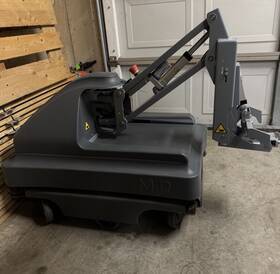
( Brand: Mir ), ( Manufacturer Part Number: HOOK-200 ), ( Part Type: Robot Hook ), ( Country Of Origin: Denmark )
Review MIR Hook 200 Mobile Industrial Robot
The **MIR Hook-200** is a cutting-edge, mobile robotic platform designed to revolutionize industrial automation, logistics, and material handling with its advanced versatility and intelligent capabilities. Engineered for high-performance applications, this autonomous robot combines robust mechanical construction with sophisticated AI-driven navigation to seamlessly integrate into dynamic environments. With a payload capacity of up to 200 kilograms, the Hook-200 excels in transporting heavy loads with precision, making it an ideal solution for warehouses, manufacturing floors, and distribution centers where efficiency and reliability are paramount. Its compact yet sturdy design allows it to navigate tight spaces and complex layouts, while its modular construction enables easy customization for diverse tasks, from pallet handling to automated guided vehicle (AGV) operations.
At the heart of the Hook-200 lies a state-of-the-art **LiDAR-based navigation system**, paired with advanced sensors and machine learning algorithms, ensuring real-time obstacle avoidance and path optimization. This intelligent mobility system enables the robot to operate autonomously or semi-autonomously, adapting to changing environments with minimal human intervention. The platform supports seamless integration with existing enterprise resource planning (ERP) and warehouse management systems (WMS), allowing for streamlined workflow automation and data-driven decision-making. Whether deployed in a high-speed fulfillment center or a precision manufacturing setting, the Hook-200 enhances operational agility while reducing labor costs and human error.
Built for durability, the Hook-200 features a **high-strength aluminum frame** and ruggedized components that withstand harsh industrial conditions, including dust, moisture, and temperature fluctuations. Its **electric powertrain** delivers consistent performance with low noise and emissions, while its **rechargeable battery system** ensures extended operational hours, minimizing downtime. The robot s **user-friendly interface**, including a touchscreen dashboard and remote control options, simplifies programming and monitoring, making it accessible for both technical and non-technical users. Additionally, its **scalable software ecosystem** supports continuous updates and feature expansions, ensuring long-term adaptability to evolving industry demands.
Beyond its core material handling capabilities, the Hook-200 is equipped with **expandable payload options**, such as robotic arms, sensors, or specialized grippers, enabling it to perform tasks like quality inspection, assembly support, or even collaborative robotics (cobot) applications. Its **collision-resistant design** prioritizes safety, with features like emergency stop mechanisms and compliance with international industrial standards. Whether deployed in a single-site operation or as part of a larger robotic fleet, the Hook-200 serves as a cornerstone for smart automation, driving productivity and innovation in modern industrial ecosystems. With its blend of power, intelligence, and flexibility, this mobile robot is not just a tool it s a strategic asset for businesses aiming to lead the next wave of automated efficiency.
### **Pros and Cons of buying a MiR Hook 200 Mobile Robot**
#### **Pros**
1. **Automation and Efficiency** The MiR Hook 200 is designed to handle repetitive material transport tasks, reducing manual labor and improving operational efficiency. It can operate 24/7 without fatigue, increasing throughput in warehouses, factories, or logistics centers.
2. **Flexibility and Adaptability** The robot is highly programmable and can be easily rerouted or reprogrammed to handle different tasks or routes. It integrates with existing warehouse management systems (WMS) and enterprise resource planning (ERP) software, making it adaptable to various workflows.
3. **Space Optimization** Unlike traditional forklifts or conveyor systems, the MiR Hook 200 is compact and can navigate narrow aisles, reducing the need for extensive infrastructure changes. It operates in shared spaces with human workers, minimizing floor space requirements.
4. **Safety Features** The robot is equipped with advanced sensors, including LiDAR, cameras, and collision detection systems, ensuring safe operation in dynamic environments. It adheres to strict safety standards and can stop or slow down when obstacles are detected.
5. **Low Operational Costs** Compared to traditional automated guided vehicles (AGVs) or forklifts, the MiR Hook 200 has lower maintenance requirements. It does not require complex infrastructure like rails or magnetic guidance systems, reducing long-term costs.
6. **Scalability** The robot can be deployed in small or large-scale operations. Additional units can be added as demand grows, making it suitable for businesses of varying sizes.
7. **User-Friendly Interface** The MiR platform is designed with intuitive software, allowing operators to program routes, assign tasks, and monitor performance without extensive technical training.
8. **Versatility in Payload Handling** The Hook 200 can carry payloads of up to 200 kg (440 lbs) and is compatible with various attachments, such as clamps, forks, or pallet handlers, making it suitable for diverse material types.
9. **Reduced Labor Costs** By automating repetitive or physically demanding tasks, businesses can reallocate human workers to higher-value activities, improving productivity and job satisfaction.
10. **Quiet Operation** The robot operates at a low noise level, contributing to a more comfortable working environment for human employees.
---
#### **Cons**
1. **High Initial Investment** While the long-term cost savings are significant, the upfront purchase or leasing cost of the MiR Hook 200 can be substantial, especially for smaller businesses or startups with limited budgets.
2. **Implementation Complexity** Integrating the robot into an existing workflow may require adjustments to processes, software, or infrastructure. Businesses may need to invest in training for employees to ensure smooth adoption.
3. **Dependence on Technology** The robot relies on software and sensors, which could potentially malfunction or require updates. Downtime due to technical issues could disrupt operations if not managed properly.
4. **Limited Off-the-Shelf Solutions** While the MiR platform is flexible, customizing the robot for highly specialized tasks may require additional development work, increasing costs and time to deployment.
5. **Workforce Transition Challenges** Employees accustomed to manual processes may resist the adoption of automation. Change management efforts, including training and communication, are necessary to ensure a smooth transition.
6. **Maintenance and Support Costs** Although lower than traditional AGVs, the MiR Hook 200 still requires periodic maintenance, software updates, and potential support from MiR s technical team, which may incur additional expenses.
7. **Not Suitable for All Environments** The robot is best suited for indoor or controlled outdoor environments with flat, stable surfaces. Uneven terrain, extreme weather conditions, or highly cluttered spaces may limit its effectiveness.
8. **Potential Job Displacement Concerns** Some employees may view the robot as a threat to their jobs, leading to resistance or productivity issues until they adapt to the new workflow.
9. **Dependency on Power Supply** The robot requires a reliable power source. If the charging station or battery fails, it could lead to operational delays until the issue is resolved.
10. **Learning Curve for Customization** While the MiR platform is user-friendly, businesses with complex automation needs may find it challenging to fully customize the robot without external support, adding to implementation time.
---
### **Conclusion**
The MiR Hook 200 is a powerful and versatile mobile robot that offers significant advantages in terms of automation, efficiency, and safety for businesses looking to streamline material transport tasks. Its flexibility, scalability, and low operational costs make it an attractive option for warehouses, factories, and logistics centers. However, the high initial investment, implementation complexity, and potential workforce resistance are factors that businesses must carefully consider.
For companies with repetitive transport tasks, limited floor space, or a need to reduce manual labor, the MiR Hook 200 can deliver substantial long-term benefits. Conversely, smaller businesses with tight budgets or highly specialized needs may find the costs or integration challenges prohibitive.
---
### **Recommendation**
**Buy the MiR Hook 200 if:**- Your business involves repetitive material transport tasks that could be automated.
- You operate in a space-constrained environment where traditional AGVs or forklifts are impractical.
- You are willing to invest in training and process adjustments to integrate the robot seamlessly.
- Long-term efficiency and cost savings justify the upfront expense.
- Your operations can benefit from 24/7 automation without significant disruptions.
**Avoid or Rethink the Purchase if:**- Your budget is limited, and the initial cost is a major concern without clear ROI projections.
- Your workflow is highly dynamic or lacks standardization, making automation difficult to implement.
- Your workforce is resistant to change, and there is no plan to address potential pushback.
- The tasks the robot is intended to perform are not repetitive or time-consuming enough to justify automation.
- Your environment is highly unpredictable (e.g., extreme outdoor conditions, uneven surfaces).
**Alternative Considerations:**- If the budget is a constraint, explore leasing options or start with a smaller-scale pilot to test the robot s effectiveness before committing to a full deployment.
- For businesses with highly specialized needs, evaluate whether a custom-built AGV or a different type of automation solution might be more suitable.
- If workforce resistance is a concern, invest in comprehensive training and change management programs to ensure smooth adoption.
Ultimately, the MiR Hook 200 is a strong choice for businesses prioritizing automation, efficiency, and scalability, provided they are prepared for the initial investment and implementation challenges. For others, a phased approach or alternative solutions may be more appropriate.
Details:
This robot is being sold as. Its been sitting for a few years and currently will not light up at all even when charging. I has one of the sensors on front a little dented.
part #: hook200 price
- $7999.99
specifications robotiindustri:
- brand: Mir
- mpn: Hook-200
- part type: Robot Hook
- country of origin: Denmark
seller robotiindustri:
- city: Greenwood, Arkansas
- # reviews: 4666
- rating: 99.8%
offer robotiindustri:
- started: May 27, 2026
- sold: 0
- availability: In Stock
- options: Ship-to-home
- quantity: 1
general robotiindustri:
- condition: For parts or not working
- Business Industrial > Industrial Automation Motion Controls > Industrial Robotic Arms
payments robotiindustri:
- wallet: Paypal
- credit card: Visa
- other
returns robotiindustri:
- policy: No Returns
shipping robotiindustri: