OTC DAIHEN FD11-UV0000 Welding Robot Cell Rotary Table Cell.
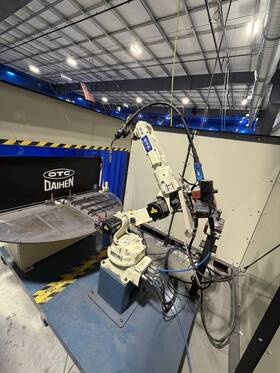
( Brand: Otc Daihen ), ( Manufacturer Part Number: FD11-UV0000 ), ( Type: Robotic Arm Assembly ), ( Arm Reach: 1410 Mm ), ( Payload: 6 Kg ), ( Robotics Controls Type: Motion Controller ), ( Construction Type: Arc Welding )
Review OTC DAIHEN Welding Robot Cell. Rotary Table
The **OTC Daihen FD11-UV0000 Welding Robot Cell with Rotary Table** represents a cutting-edge solution for manufacturers seeking to automate high-precision welding operations with unmatched efficiency and reliability. Designed for integration into modern production environments, this compact yet robust welding cell combines the advanced capabilities of Daihen s FD11 welding robot a six-axis articulated arm known for its exceptional repeatability and dynamic motion with a high-torque rotary table that ensures seamless part positioning and consistent weld quality. The rotary table, equipped with a precise indexing system and robust drive mechanism, allows for 360-degree rotation with minimal backlash, making it ideal for applications requiring complex part orientation, such as cylindrical components, pipes, or asymmetrical geometries. The cell s modular design facilitates easy setup and reconfiguration, enabling quick adaptation to different welding tasks without compromising accuracy. With a payload capacity of up to 110 kg (depending on the specific rotary table variant), this system is well-suited for medium to large-scale production, handling everything from automotive chassis components and industrial machinery parts to specialized aerospace or medical device fabrication. The FD11 robot itself is engineered with a lightweight yet durable structure, featuring high-speed servo drives and a wide range of motion, which minimizes cycle times while maintaining tight positional tolerances critical for applications demanding flawless weld seams. Additionally, the cell is equipped with integrated safety features, including light curtains, emergency stop mechanisms, and collision detection, ensuring a secure working environment for operators. The system s compatibility with industry-standard programming interfaces, such as Daihen s proprietary software or third-party CAD/CAM tools, allows for seamless integration into existing production lines, while its open architecture supports the incorporation of vision systems, force sensors, or other automation peripherals for enhanced process control. Whether deployed in a dedicated welding bay or integrated into a larger automated production line, the **OTC Daihen FD11-UV0000 Welding Robot Cell with Rotary Table** delivers a versatile, high-performance solution that elevates productivity, reduces labor costs, and ensures superior weld consistency making it an indispensable asset for forward-thinking manufacturers aiming to optimize their welding operations.
**Pros and Cons of buying a OTC Daihen FD11-UV0000 Welding Robot Cell with Rotary Table**
### **Pros**
1. **High Precision and Consistency** The Daihen FD11-UV0000 is a well-regarded industrial welding robot known for its accuracy in repetitive tasks. The rotary table enhances versatility, allowing for precise positioning of cylindrical or irregularly shaped parts, which improves weld quality and reduces defects.
2. **Efficiency and Productivity** Automated welding reduces human error and speeds up production. The robot can operate continuously without fatigue, increasing throughput, especially in high-volume manufacturing environments. The rotary table further streamlines workflows by automating part rotation, minimizing manual handling.
3. **Versatility in Welding Applications** The FD11-UV0000 supports multiple welding processes (e.g., MIG, TIG, or arc welding) and can handle various materials, including steel, aluminum, and stainless steel. The rotary table expands its utility for welding pipes, tanks, or complex geometries, making it suitable for industries like automotive, aerospace, and heavy machinery.
4. **Reduced Labor Costs** By automating welding tasks, businesses can reallocate human labor to more skilled or supervisory roles, lowering operational costs over time. The robot also reduces the need for highly trained welders, though initial training on the system may still be required.
5. **Improved Workplace Safety** Welding robots eliminate exposure to hazardous fumes, intense heat, and repetitive strain injuries associated with manual welding. The enclosed or semi-enclosed design of the cell further minimizes risks like sparks or UV radiation.
6. **Scalability and Integration** The Daihen FD11-UV0000 can be integrated into existing production lines or CNC systems. Its modular design allows for future upgrades, such as adding more axes or sensors, to adapt to evolving manufacturing needs.
7. **Data Collection and Quality Control** Modern welding robots like this model often come with software for tracking weld parameters, cycle times, and defects. This data can be used for quality assurance, predictive maintenance, and process optimization.
8. **Long-Term Durability** Daihen is a reputable manufacturer with a history of producing robust industrial robots. The FD11-UV0000 is built for heavy-duty use, ensuring longevity with proper maintenance.
---
### **Cons**
1. **High Initial Investment** The upfront cost of purchasing a welding robot cell, including the rotary table, can be substantial. This may be a barrier for small businesses or startups with limited capital. Additional expenses may include installation, programming, and initial training.
2. **Complex Setup and Programming** Configuring the robot for specific welding tasks requires expertise in robotics programming and welding parameters. Businesses may need to hire specialized personnel or invest in training to operate the system effectively. Customizing the rotary table for non-standard parts can also add complexity.
3. **Maintenance and Downtime** Industrial robots require regular maintenance to ensure optimal performance. Components like joints, wiring, and sensors may wear out over time, leading to potential downtime if not addressed promptly. The rotary table, in particular, may require periodic calibration to maintain precision.
4. **Space Requirements** A welding robot cell occupies significant floor space, which may not be feasible for companies with limited production areas. The rotary table further adds to the footprint, requiring careful layout planning.
5. **Dependency on Technology** Over-reliance on automation can create vulnerabilities. Technical failures, power outages, or software glitches could halt production. Businesses must have contingency plans, such as backup systems or manual overrides, to mitigate risks.
6. **Reskilling Workforce** Employees accustomed to manual welding may resist transitioning to robotic operations. Companies must invest in training to ensure smooth adoption and prevent productivity losses during the transition period.
7. **Limited Flexibility for Small Batches** While the robot excels in high-volume, repetitive tasks, it may not be cost-effective for producing small batches of custom or one-off parts. Switching between different welding jobs can require reprogramming and setup changes, adding time and cost.
8. **Potential for Overcapacity** If demand does not justify the robot s output, the investment may not yield a sufficient return on investment (ROI). It s crucial to assess long-term production needs before purchasing.
---
### **Conclusion**
The OTC Daihen FD11-UV0000 welding robot cell with rotary table is a powerful tool for businesses seeking to enhance precision, efficiency, and safety in their welding operations. Its strengths lie in its ability to deliver consistent, high-quality welds at scale, reduce labor costs, and improve workplace safety. The rotary table adds significant versatility, making it ideal for industries requiring complex part handling.
However, the high initial cost, complexity of setup, and maintenance requirements present challenges, particularly for smaller businesses or those with fluctuating production needs. Success with this system depends on careful planning, adequate training, and a clear understanding of how it aligns with long-term business goals.
### **Recommendation**
**Purchase the Daihen FD11-UV0000 if:**- Your business operates in a high-volume manufacturing environment where repetitive welding tasks dominate.
- You have the budget to cover the upfront cost and potential maintenance expenses.
- Your production line can accommodate the space and integration requirements.
- You are willing to invest in training employees to operate and program the robot effectively.
- The rotary table s capabilities align with your need to weld cylindrical or irregularly shaped parts.
**Avoid purchasing if:**- Your production volume is low or highly variable, making the robot s efficiency less impactful.
- You lack the technical expertise or resources to set up, program, or maintain the system.
- The initial cost cannot be justified by expected ROI within a reasonable timeframe.
- Your workspace is constrained, and the robot cell would disrupt existing workflows.
**Alternative Considerations:**- If budget is a concern, explore leasing options or purchasing a used robot cell.
- For smaller operations, evaluate whether a standalone robot (without a full cell) or a simpler rotary table setup would suffice.
- Conduct a pilot test or consult with Daihen s distributors to assess compatibility with your specific applications before committing to a purchase.
Ultimately, the Daihen FD11-UV0000 is a sound investment for businesses prioritizing automation, precision, and scalability in welding operations, provided their operational and financial conditions support it.
Details:
OTC Daihen welding robot cell. Machine is 2012, but came from a tech center. Has a Weber 400 welding supply. You won't find an easier to use robot with superior weld quality.
Rotating table. FD11 control. Set up for welding steel.
part #: fd11uv0000 price
- $55000.00
specifications robotiindustri:
- brand: Otc Daihen
- mpn: Fd11-uv0000
- type: Robotic Arm Assembly
- arm reach: 1410 Mm
- payload: 6 Kg
- robotics controls type: Motion Controller
- construction type: Arc Welding
shipping robotiindustri:
payments robotiindustri:
- credit card: Mastercard
- wallet: Paypal
- wire transfer
offer robotiindustri:
- availability: In Stock
- best offers: True
- sold: 0
- quantity: 1
- options: Seller-arranged-local-pickup
- started: May 27, 2026
returns robotiindustri:
- policy: No Returns
seller robotiindustri:
- # reviews: 1366
- rating: 100.0%
- city: Kalamazoo, Michigan
general robotiindustri:
- Business Industrial > Industrial Automation Motion Controls > Industrial Robotic Arms
- condition: Used
Otc Daihen FD11-UV0000 Is Similar To:
- 602 Otc-daihen Otc Daihen Irb-601 (29.5% similar) Your satisfaction is our highest priority. Please with any and all questions as your satisfaction is our highest priority. Otc Daihen robot model IRBC-602YEAR: 2000 PRODUCT condition: used - this system is used, but in perfect working order. A: most popular. The system was taken care of - as seen ...(October 17th, 2017)
- A2tpddnn-uc08 Otc Daihen Ax Teach Pendant Used (27.7% similar) Thanks,Luke. Hi, this offer is for an ax teach pendant. This pendant is used but in good working condition...(July 13th, 2018)
- Ax-v6 Otc Daihen Welding Robot (56.5% similar) Complete welding cell to include 1000KG 2 axis positioned. Comes with light weight movable cell walls...(February 8th, 2019)
- D55478 Otc Daihen D010066-1 Power (40.9% similar) Otc Daihen D010066-1 D55478 power supply L5561 Dr control LOC1253...(November 14th, 2017)
- Dm-350 Daihen Welder Otc Digital Inverter Welding Machine (37.5% similar) Features: - high quality welding in low current range reduced spatter with digital electronic reactor stable by penetration adjustment function perfect arc starts for reliable operations item is used but fully operational. 5 v rated output current range a voltage duty cycle 60 external dimensions ...(July 2nd, 2018)
- Dr-4200 Otc Daihen Dynamic Robot Dr Control Controller Teach Pendant (42.3% similar) Otc Daihen dynamic robot DR-4200 w Dr control 2 controller L5807A teach pendant used in excellent good cosmetic and very clean condition. Comes as pictured. See the pictures. So, sold as is with no return. No key and other accessories. Inventory id: armada, OK...(April 17th, 2019)
- E4477a Daihen Sale Otc Teaching Boxes Cables Robotics Pendant Japanese (38.4% similar) In the event my is inaccurate, don't hesitate to bring this attention during offer. 2 boxes cables as shown in photographs. Daihen Otc teaching boxes cables clean, used pendant box from closed semi-conductor plant. The fine print you are purchasing items often used or with limited history that ...(May 22nd, 2018)
- E6237 Otc Daihen Model Operation (41.4% similar) Otc Daihen model E6237 operation box LOC1254...(November 19th, 2017)
- L00954 Dm22q01 Otc Daihen Capacitor Module Dr Control (29.6% similar) Otc Daihen capacitor module Dr CONTROLL00954, DM22Q01...(May 17th, 2018)
- L10597d00 Otc Daihen Conduit (33.7% similar) Please with any questions...(May 17th, 2018)
- L4795d00a Otc Daihen Power Cord (37.2% similar) Otc Daihen power cord L4795D00A LOC1254...(November 21st, 2017)