UNIVERSAL ROBOTICS 1005682 Robot Control Box Module
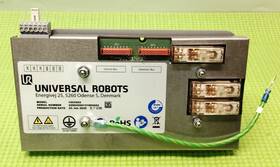
( Brand: Universal Robotics ), ( Manufacturer Part Number: 1005682 ), ( Type: Industrial Robot Control Box Module )
Review UNIVERSAL ROBOTICS Industrial Robot Control Box Module Assembly Robots
The **Robotics 1005682 Robot Control Box Module** is a high-performance, modular powerhouse designed to elevate the functionality and precision of robotic systems across a wide range of applications, from industrial automation and educational robotics to custom-built hobbyist projects. Engineered with cutting-edge microcontroller technology and robust signal processing capabilities, this compact yet versatile control module serves as the brain and backbone of any robotic platform, seamlessly integrating motor drivers, sensor inputs, and communication interfaces into a cohesive control architecture. Its modular design allows for easy expansion and customization, accommodating a variety of motor types including brushed DC, brushless DC, and stepper motors while supporting high-current outputs through integrated H-bridge drivers or dedicated motor controller ports. The module features a rich array of digital and analog I/O pins, enabling real-time feedback from encoders, limit switches, and other sensors, which are processed via its embedded firmware or programmable logic for dynamic response and adaptive control. Communication protocols such as UART, I2C, SPI, and even Wi-Fi or Bluetooth modules (depending on the variant) ensure seamless integration with external devices, PCs, or cloud-based platforms, facilitating remote monitoring, firmware updates, and advanced teleoperation. Built with durability in mind, the control box is housed in a rugged, heat-dissipating enclosure that protects sensitive electronics from environmental interference while maintaining operational efficiency under demanding conditions. Whether deployed in a factory setting for precise CNC machining, a research lab for experimental robotics, or an educational classroom to teach programming and engineering principles, this control module delivers unparalleled flexibility, reliability, and scalability, empowering engineers and enthusiasts to bring their robotic visions to life with precision and ease.
### **Pros and Cons of buying a Robotics 1005682 Robot Control Box Module**
The **Robotics 1005682 Robot Control Box Module** is designed for use in robotic systems, typically for educational, hobbyist, or small-scale automation projects. Below is a detailed analysis of its advantages and disadvantages.
---
### **Pros**
1. **Compatibility with Common Robotics Platforms**
The module is likely designed to integrate with popular robotics kits, such as LEGO Mindstorms, Arduino-based robots, or other DIY robotic systems. This makes it a versatile choice for users who are expanding or customizing existing setups.
2. **Modular and Expandable Design**
As a control box module, it may allow for easy addition of sensors, actuators, or communication interfaces (e.g., Bluetooth, Wi-Fi, or serial ports). This modularity enables users to adapt the system for different applications without major redesigns.
3. **Cost-Effective for Educational and Hobbyist Use**
Compared to fully integrated commercial robotic systems, this module is likely more affordable. It provides a cost-efficient way for students, hobbyists, or small businesses to experiment with robotics without investing in expensive proprietary solutions.
4. **Simplified Control Logic**
The module may abstract complex control functions, allowing users to focus on higher-level programming (e.g., movement algorithms, sensor processing) rather than low-level hardware management. This is particularly useful for beginners learning robotics.
5. **Support for Multiple Communication Protocols**
Depending on the module s specifications, it may support protocols like PWM (Pulse Width Modulation), I2C, UART, or even motor driver interfaces. This flexibility ensures compatibility with a wide range of actuators and sensors.
6. **Easy Installation and Setup**
Since it is a standalone module, users can plug it into their robotic system without extensive soldering or complex wiring. This reduces assembly time and lowers the barrier to entry for non-experts.
7. **Potential for Customization**
Users with intermediate electronics knowledge may be able to modify or upgrade the module (e.g., adding shields, changing firmware) to suit specific project requirements.
8. **Good for Prototyping**
Ideal for testing new robotic concepts before committing to a full-scale build. The module allows rapid iteration and experimentation with different control strategies.
---
### **Cons**
1. **Limited to Basic Applications**
The module may not be suitable for advanced or industrial-grade robotics, which require high precision, reliability, and robustness. It is likely designed for low-to-medium complexity tasks rather than heavy-duty automation.
2. **Dependence on External Power Supply**
If the module does not include a built-in power source or regulator, users may need to provide a stable external power supply (e.g., batteries or AC adapter). Inconsistent power can lead to erratic performance or damage to connected components.
3. **Potential Lack of Documentation**
Some third-party or lesser-known modules may come with insufficient documentation, making troubleshooting or customization difficult. Users may need to rely on community forums or trial-and-error methods.
4. **Limited Processing Power**
Unlike dedicated microcontrollers (e.g., Raspberry Pi, Arduino Mega), the module may have restricted processing capabilities. Complex algorithms or real-time control tasks might require additional hardware or optimizations.
5. **Compatibility Issues with Non-Standard Components**
If the robotic system uses non-standard sensors, motors, or communication protocols, the module may not support them out of the box. Users might need to build custom interfaces or adapters.
6. **No Built-In Error Handling or Redundancy**
The module may lack features like fault detection, auto-recovery, or redundant power paths, which are critical in professional or safety-critical applications. A failure in the module could halt the entire robotic system.
7. **Potential for Outdated Technology**
If the module is older or not frequently updated, it may not support modern communication standards (e.g., Bluetooth 5.0, Wi-Fi 6) or newer sensor technologies. This could limit future upgrades.
8. **Dependence on Third-Party Support**
If the manufacturer provides limited or no customer support, issues like hardware failures or software bugs may be difficult to resolve without community assistance.
---
### **Conclusion**
The **Robotics 1005682 Robot Control Box Module** is a practical choice for **educational projects, hobbyist robotics, and small-scale automation tasks** where cost, simplicity, and modularity are prioritized. It excels in scenarios where users need a flexible, easy-to-integrate control solution without investing in high-end industrial systems.
However, it is **not ideal for professional, high-precision, or safety-critical applications** due to its likely limitations in processing power, error handling, and compatibility with advanced components. Users should carefully assess their project requirements before purchasing, ensuring the module aligns with their needs in terms of performance, scalability, and long-term support.
---
### **Recommendation**
- **Buy if:**- You are a student, hobbyist, or small business working on a **low-to-medium complexity robotic project**.
- You need a **cost-effective, modular control solution** that integrates with existing robotic kits.
- Your project does not require **high-speed processing, real-time control, or industrial-grade reliability**.
- You are comfortable with **basic electronics and programming** to troubleshoot or customize the module.
- **Avoid if:**- You are building a **professional or safety-critical robotic system** (e.g., medical robots, autonomous vehicles, or factory automation).
- You require **high precision, redundancy, or advanced sensor integration**.
- The module lacks **comprehensive documentation or manufacturer support**.
- Your project demands **future-proof technology** (e.g., support for emerging IoT or AI-driven controls).
For **advanced or commercial applications**, consider investing in **dedicated microcontrollers (e.g., Raspberry Pi, STM32), industrial-grade PLCs, or commercial robotic control systems** from brands like **ABB, Fanuc, or Texas Instruments**. For **educational or hobbyist use**, the 1005682 module remains a solid, budget-friendly option.
Details:
2 Choose a reason for the return. 3 If the item arrived damaged or defective, you can upload up to 10 photos show any issues. As seen in photos. C2, Hello, You are buying ONE 1 Industrial Robot Control Box Module Assembly 1005682 Universal Robots, Used and in good condition.
Please review all photos carefully to ensure part numbers and compatibility match your application before purchase.
part #: 1005682 price
- $2999.99
specifications robotiindustri:
- brand: Universal Robotics
- mpn: 1005682
- type: Industrial Robot Control Box Module
offer robotiindustri:
- quantity: 1
- availability: In Stock
- options: Ship-to-home
- sold: 0
- best offers: True
- started: May 27, 2026
shipping robotiindustri:
- class: Standard
- service: USPS Ground Advantage
- carrier: USPS
- type: Calculated
- transit: 2-6 Days
- cost: $14.10
payments robotiindustri:
- wallet: Paypal
- credit card: Diners-club
- other
returns robotiindustri:
- time: 30 Days
- policy: Returns Accepted
- method: Money back
- paid by: Buyer
general robotiindustri:
- condition: Used
- Business Industrial > Industrial Automation Motion Controls > Industrial Robotic Arms
seller robotiindustri:
- # reviews: 2042
- rating: 99.6%
- city: Ypsilanti, Michigan
Universal Robotics 1005682 Is Similar To:
- 980-6014 Robitech Universal Interface Module (36.1% similar) Pulled from a working panel comes as shown...(October 2nd, 2017)
- A05b-2490-c101 Fanuc Universal Robot I-pendant (35.5% similar) Brand new unused Universal fang i-pendant...(March 26th, 2017)
- Pgn160-1 Psk40-n-1 Schunk Universal Robotic Gripper Swivel Head Assembly (42.7% similar) width : 10 in. We choose the carrier. We get hundreds of items in daily, if don't have it today check back tomorrow. height : 10 in. Need it urgently. Next day second air services are available. After the return period has ended, you can no longer product. Domestic shipping price is shown for us ...(March 12th, 2018)
- Pgn160-2 Schunk Universal Robotic Gripper Head Assembly (45.1% similar) We choose the carrier. Domestic shipping price is shown for us lower 48 states. After the return period has ended, you can no longer product. We get hundreds of items in daily, if don't have it today check back tomorrow. Need it urgently. Next day second air services are available...(October 24th, 2018)
- 110103 Universal Robots New Ur3 Collaborative Industrial Robotic Arm Flexible 6 Axis (53.1% similar) UR3 technical specifications 6 axis robot arm with a working radius of 500MM lbs, bringing value to scientific, pharmaceutical, agriculture, and electronics and technology facilities. The ultra flexible Universal robots UR3 delivers high precision accuracy for smaller production environments. Other ...(October 16th, 2015)
- Ur-10 Universal Robots Robot Robotic Arm Very Low Hours Great Condition (38.9% similar) Pelleting, packaging, assembly, and pick place where the distance between different operating areas is longer. 1 millimeters. 2 inches making it especially suitable for the UR-10 allows for payloads of up to 10KG 22 lbs, while maintaining repeatable precision. The UR-10 is largest, most expensive, ...(July 13th, 2018)
- Ur 5 Universal Robots With Axis System (42.7% similar) I will give you all of the software and if helpful, consult to assist in any further development. Total system includes Universal robots UR-5 5KG capacity robot, Ur caps control software, tested and vetted. Complete 7TH axis collaborative robotic system, all source code included in purchase. Also ...(January 26th, 2019)
- Ur10e Universal Robots With Axis From Vention (40.7% similar) The machine is 50 inches deep, and 57. 5 inches tall, though the of robot is mounted at about from ground. The machine is 97. It comes with a 3 output motion controller, as we were originally going to add z axis well. The controller also has beta version of Ur caps program from venation now 850 site...(March 28th, 2019)
- 110105 Universal Robots Robotic Arm With Robotiq Model Gripper (44.3% similar) 5 ins 850MM, the UR5 collaborative robot puts everything within reach, freeing up your employees time to add value other stages of production. With a working radius of up to 33. The UR5 flexible robot is ideal to optimize low-weight collaborative processes, such as picking, placing, and testing. UR5...(April 8th, 2020)
- 20185501087 Universal Robot Robotiq Gripper Base Barely Used For (43.7% similar) Base can be locked and moved around easily. Link to video of the robot showing it works fine: s: drive. Universal robot 5e robotic gripper 2F-85 wheeled base 24 X24 X32 codex barely used for tel-operation was purchased new DEC 2018 . FILE1S-G6L5B4VCTFOEVCWTCDPPBB weedless view...(April 10th, 2020)
- Universal Robot Cb31ur10 Ur10 2018 (33.9% similar) Very few hours have been put on this unit. Used for training purposes. This robot is essentially brand new. Universal robot UR10 CB31UR10 2018...(September 23rd, 2023)