PANASONIC TA-1400 Robot Welding Arm
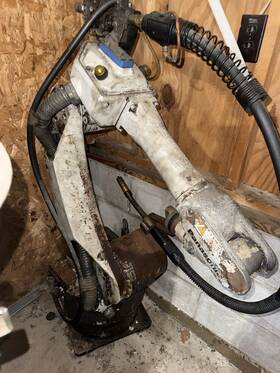
( Brand: Panasonic ), ( Manufacturer Part Number: TA-1400 ), ( Part Type: Robot Arm ), ( Robotics Controls Type: Arm )
Review PANASONIC Robot Welding Arm
The **Panasonic TA-1400 Robot Welding Arm** is a high-performance, compact yet versatile robotic solution designed to elevate precision, efficiency, and flexibility in automated welding applications. Engineered for industries ranging from automotive and aerospace to general manufacturing, this advanced robotic arm combines cutting-edge technology with robust build quality to deliver seamless integration into production environments. With a reach of up to **1,400 millimeters** and a payload capacity of **10 kilograms**, the TA-1400 excels in handling a wide array of welding tasks, from spot welding and MIG to TIG and resistance welding, while maintaining exceptional repeatability and accuracy. Its **6-axis articulated design** ensures smooth, dynamic movement, allowing for intricate weld paths and complex part orientations with minimal setup time. The arm s **high-speed servo motors** and **closed-loop control system** enable rapid acceleration and deceleration, reducing cycle times without compromising weld quality. Equipped with **Panasonic s proprietary welding control algorithms**, the TA-1400 optimizes arc stability, heat input, and seam tracking, resulting in cleaner welds and reduced post-processing requirements. Its **compact footprint** and modular mounting options make it ideal for integration into tight spaces or existing production lines, while the **user-friendly programming interface** simplifies task setup, even for operators with limited robotic experience. Additionally, the system supports **offline programming (OLP)** and **collaborative robot (cobot) safety features**, allowing for easy programming and safe human-robot interaction in shared workspaces. Built with durability in mind, the TA-1400 features a **rigid, corrosion-resistant structure** and **low-maintenance components**, ensuring long-term reliability in demanding industrial environments. Whether deployed in high-volume production lines or specialized fabrication shops, this robotic welding arm represents a strategic investment in automation, driving productivity, consistency, and cost savings while adapting to evolving manufacturing needs.
**Pros and Cons of buying a Panasonic TA-1400 Robot Welding Arm**
### **Pros**
1. **High Precision and Consistency** The TA-1400 is designed for high-precision welding tasks, reducing human error and ensuring repeatable results. Its advanced control system allows for smooth, accurate movements, which is critical in industries like automotive, aerospace, and manufacturing.
2. **Versatility in Applications** This robot is capable of handling multiple welding processes, including MIG, TIG, and spot welding, making it adaptable to various production needs. Its six-axis configuration allows for complex movements, including welding in tight or hard-to-reach areas.
3. **User-Friendly Interface** Panasonic s programming software is intuitive, allowing operators to program welding paths, speeds, and parameters with relative ease. The teach pendant is ergonomic, reducing operator fatigue during setup.
4. **Durability and Reliability** Built with industrial-grade components, the TA-1400 is designed for continuous operation in demanding environments. Panasonic s reputation for robust automation equipment suggests long-term reliability, reducing downtime.
5. **Energy Efficiency** The robot is optimized for energy-efficient operation, which can lower operational costs over time. Its servo-driven motors adjust power consumption based on task requirements.
6. **Integration with Existing Systems** The TA-1400 can be easily integrated with CNC machines, conveyors, and other automation systems, making it suitable for expanding or upgrading existing production lines.
7. **Safety Features** Equipped with safety sensors and programmable safety zones, the robot helps prevent accidents by restricting movement in hazardous areas and ensuring compliance with workplace safety standards.
8. **Compact Design** Its relatively compact footprint allows for installation in smaller workshops or facilities where space is limited, without sacrificing performance.
9. **Maintenance-Friendly** Panasonic robots are known for their modular design, making maintenance and repairs more straightforward. Access to components is often easier compared to some competitors.
10. **Support and Warranty** Panasonic offers comprehensive technical support, training programs, and warranty coverage, which can be valuable for businesses new to robotic welding.
---
### **Cons**
1. **High Initial Cost** The TA-1400 is a mid-to-high-end robot, and the upfront investment can be significant, especially for small businesses or startups. Additional costs may include programming, installation, and training.
2. **Training Requirements** Operating and programming the robot effectively requires skilled personnel. Businesses may need to invest in training for employees or hire specialized technicians, adding to operational costs.
3. **Limited Payload Capacity** With a payload of up to 14 kg (30.9 lbs), the TA-1400 may not be suitable for heavy-duty welding tasks or applications requiring the manipulation of large or bulky materials. Larger payload robots would be needed for such purposes.
4. **Software Learning Curve** While the interface is user-friendly, mastering advanced programming features (e.g., path optimization, adaptive welding) may take time. Some users report that Panasonic s software lacks the depth of alternatives like FANUC or ABB in certain advanced applications.
5. **Dependence on Power Supply** Like all robotic systems, the TA-1400 requires a stable power source. Power fluctuations or outages can disrupt operations, and backup systems may be necessary in some environments.
6. **Customization Limitations** For highly specialized applications, businesses may need to invest in additional peripherals (e.g., custom end-effectors, vision systems) that are not included with the base model.
7. **Resale Value** Robotic equipment, including Panasonic robots, typically depreciates over time. While the TA-1400 is reliable, its resale value may not fully offset the initial cost after several years of use.
8. **Compatibility with Third-Party Tools** Integration with non-Panasonic systems (e.g., CAD/CAM software, PLCs from other manufacturers) may require additional middleware or custom development, adding complexity.
9. **Space Constraints** Although compact, the robot still requires adequate workspace around it for safe operation and programming. Workshops with tight layouts may struggle to accommodate it without modifications.
10. **Potential for Overkill** For very small-scale operations or one-off welding tasks, the TA-1400 may be overkill. In such cases, a manual welding setup or a simpler robotic arm could be more cost-effective.
---
### **Ending Conclusion**
The Panasonic TA-1400 robot welding arm is a well-engineered, versatile tool suited for businesses seeking to automate welding processes with precision and reliability. Its strengths lie in its ease of use, adaptability to various welding techniques, and robust build quality, making it ideal for mid-to-large-scale manufacturing environments where consistency and efficiency are prioritized. However, the high initial cost, training needs, and potential limitations in payload capacity or advanced customization must be carefully considered. For companies with the budget and operational scale to justify automation, the TA-1400 offers a strong return on investment through improved productivity, reduced labor costs, and higher-quality welds. Conversely, smaller operations or those with limited technical resources may find it more prudent to start with a simpler robotic solution or manual processes before investing in this level of automation.
---
### **Recommendation**
**Buy the Panasonic TA-1400 if:**- Your business requires high-precision, repeatable welding for automotive, aerospace, or industrial manufacturing.
- You have the budget to cover the upfront cost and potential training expenses.
- Your workspace and workflow can accommodate robotic integration without major disruptions.
- You prioritize long-term reliability, energy efficiency, and ease of maintenance over cutting-edge customization.
- You plan to scale production and justify the investment through increased output and reduced labor costs.
**Avoid or Consider Alternatives if:**- Your operation is small-scale or lacks the technical expertise to operate and program the robot effectively.
- Your welding tasks involve very heavy materials or require payloads significantly beyond 14 kg.
- You need advanced features (e.g., AI-driven path optimization) that the TA-1400 does not fully support.
- Your budget is tight, and you can achieve similar results with a lower-cost robotic arm or manual welding setup.
- You anticipate rapid changes in production needs that may make the robot obsolete quickly.
For businesses on the fence, a trial period or consulting with Panasonic s sales team to assess specific use cases could help determine whether the TA-1400 aligns with your goals. Additionally, exploring financing options or leasing programs may help manage the initial cost burden.
Details:
Panasonic TA-1400 robot welding arm with model no. My job allowed me to take it home and has just been sitting in the garage since. YA-1QAR61 robot controller. Wires were cut while removing but do have all of them including the pendant.
This robot did work and weld before being decommissioned in 2020.
part #: ta1400 prices
- $2020.00-$8750.00
specifications robotiindustri:
- brand: Panasonic
- mpn: Ta-1400
- part type: Robot Arm
- robotics controls type: Arm
returns robotiindustri:
- policy: No Returns
seller robotiindustri:
- rating: 100.0%
- # reviews: 5
- city: McMinnville, Tennessee
shipping robotiindustri:
- service: Flat Rate Freight
- type: Fixed
- cost: $1000.00
- class: Freight
general robotiindustri:
- condition: Used
- Business Industrial > Industrial Automation Motion Controls > Industrial Robotic Arms
payments robotiindustri:
- other
- credit card: Visa
- wallet: Google-pay
offer robotiindustri:
- options: Ship-to-home
- sold: 0
- quantity: 1
- best offers: True
- availability: In Stock
- started: February 26, 2026
Panasonic TA-1400 Is Similar To:
- Akp00001 Matsushita Panasonic Robot Robotic (43.6% similar) Test results of items in offer are described to the best our ability ad. Mutsuhito robot robotic teach pendant operator panel keypad AKP00001 used 01 we gladly ship worldwide scroll down for more photos and details Panasonic fairly good condition. What you see in the pictures is get nothing more ...(May 6th, 2017)
- Aur01060 Panasonic Teach Pendant Robot Controller (50% similar) Condition is new. Shipped with USPS priority mail. Panasonic teach pendant AUR01060 g3 robot controller...(March 16th, 2018)
- Dh 5691k National Panasonic Collector Arm Fnob (39.5% similar) Special instructions. National DH 5691K Panasonic collector arm, 1P, 600V, 60A fob manufactured by manufacturer part number: a new product with open packaging. Join our subscribe to news letter for exclusive discounts and special offers...(July 6th, 2018)
- Nm-1375 Matsushita Panasonic Panadac Robot Control (47.1% similar) 00LOT of 250 Victorian EAP0243L00A subs PC board T45457 200 D55342K07B1E21R, F15-C01-B05 fixed film resistors T59316 here to via message related items barista ARP-1608AP LCD touch screen T83908 1,999. Industrial supplies industrial equipment fiber optic slab equipment restaurant equipment industrial...(September 3rd, 2018)
- Aw-005c Panasonic Working Welding Robot With Positioner Model Aw005c (40.8% similar) No interface box is required and no complicated wiring is necessary. The used Panasonic aw 005 c, with enhanced output through standard functions including error recovery, hot edit, weld selection shift, resume function, weld monitor, network capabilities and flying arc start end. The conventional ...(July 19th, 2016)
- Aw-005cl Panasonic Panarobo 6-axis Robotic Welding Cell (60% similar) At the time the anaerobe was the only system that I could find that was all inclusive the robot, controller, welder, and pendant via the same company. To make a long story short, this cable was never replaced, as the job requiring the robotic welding cell was lost. It was truly a turn key system for...(August 25th, 2016)
- Vr-006 Panasonic Robot With G2 Controller (52.6% similar) A push pull controller. Can be set up to be a fully functioning machine relatively cheap. Used Panasonic robot. Comes with yd 350 GE2 welding power supply. Missing pendant, wire feeder, and torch. 4 welding interfaces...(June 3rd, 2016)
- Sf32g0cr51u Panasonic Robot Harmonic Set (48% similar) SF32G0CR51U Panasonic robot harmonic set for AW5CL...(February 14th, 2017)
- Ta-1600 Panasonic Welding Robot With (50.7% similar) This used robot has a reach of 1598MM. This Panasonic TA1600 uses the g-ii controller. Panasonic TA-1600 welding robot the is designed for arc welding, robotic and plasma applications. View all used robots for sale here robot has been tested and verified to be in good working order. Integrating used...(July 28th, 2017)
- Vr-006al Panasonic Robotic Mig Welding System (62.5% similar) ...(July 25th, 2018)
- Vr-008 Panasonic Robot Bw Harmonic Set (52.1% similar) Panasonic robot Be harmonic set for VR-008 with bearings and pulley...(February 24th, 2017)