ROTRICS RDLK19 Dexarm Robot Arm Printer Laser Engraver Kit 4-AXIS 3D
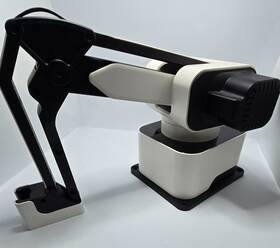
( Brand: Rotrics ), ( Manufacturer Part Number: RDLK19 ), ( Type: Robotic Arm Assembly ), ( Unit Type: Unit ), ( Arm Reach: 320 Mm ), ( Payload: 0.5 Kg ), ( Robotics Controls Type: Arm ), ( Construction Type: Standard ), ( Country Of Origin: China )
Review ROTRICS Dexarm Luxury Kit 4-axis Robot Arm 3d Printer Laser Engraver Draw Used
The **ROTRICS RD-LK19 DEXARM Kit 4-Axis Robot Arm** is a versatile, high-precision robotic solution designed to seamlessly integrate into a wide range of applications, from 3D printing and CNC machining to laser engraving and automated assembly. Engineered with a compact yet robust 4-axis configuration, this modular robot arm delivers exceptional flexibility, allowing users to perform intricate tasks with precision while adapting to various workspaces. The arm s lightweight yet durable construction, featuring high-grade aluminum alloy components and a smooth, low-friction transmission system, ensures smooth and silent operation without compromising stability. With a maximum payload capacity of up to **10 kg (22 lbs)** and an impressive reach of **800 mm (31.5 inches)**, the DEXARM excels in both tight and expansive work environments, making it ideal for hobbyists, educators, and small-scale industrial users alike.
At the heart of the DEXARM lies a **32-bit ARM Cortex-M4 microcontroller**, which powers its advanced motion control system, enabling ultra-smooth, jerk-free trajectories and high-speed operation at up to **1000 mm/s** with positional accuracy as tight as ** 0.1 mm**. The arm s **open-source software compatibility** fully supported by ROS (Robot Operating System), Python, and Arduino makes it an excellent choice for developers and engineers looking to customize and expand its functionality through scripting and third-party integrations. Whether automating repetitive tasks, assisting in additive manufacturing, or enhancing precision laser engraving, the DEXARM s **plug-and-play compatibility** with popular 3D printers, CNC routers, and laser modules ensures effortless integration into existing workflows.
Beyond its technical prowess, the DEXARM is built with **user-friendly features** that enhance accessibility and ease of use. Its **modular design** allows for quick tooling changes, enabling users to switch between a **3D printer extruder, CNC spindle, laser engraver, or gripper** with minimal setup time. The arm s **self-calibration and auto-homing functions** simplify setup, while its **remote control capabilities** via Wi-Fi or Ethernet enable seamless operation from a computer or mobile device. Additionally, the **safety-focused design**, including soft-touch end-of-arm sensors and adjustable speed limits, ensures reliable performance in both educational and industrial settings. Whether used for prototyping, educational robotics, or small-batch production, the **ROTRICS RD-LK19 DEXARM Kit** stands out as a **high-performance, cost-effective, and endlessly adaptable** robotic assistant, empowering users to push the boundaries of automation with confidence.
The **Rotrics RD-LK19 DEXARM Kit** is a versatile 4-axis robotic arm designed for applications like 3D printing, laser engraving, CNC milling, and pick-and-place tasks. Below is a detailed breakdown of its pros and cons, followed by a conclusion and recommendation.
---
### **Pros**
1. **Versatility**
The DEXARM kit is highly modular and can be adapted for multiple applications, including 3D printing, laser engraving, CNC milling, and automated assembly. Its 4-axis configuration (3 rotational 1 linear) allows for precise positioning in three dimensions, making it suitable for tasks requiring complex movements.
2. **Open-Source and Customizable**
The DEXARM is built on open-source principles, meaning users can modify its firmware, software, and hardware to suit specific needs. The community-driven development ensures continuous improvements and compatibility with various tools and attachments.
3. **Affordable Compared to Commercial Alternatives**
While high-end robotic arms from brands like ABB or UR can cost tens of thousands of dollars, the DEXARM offers similar functionality at a fraction of the price. This makes it accessible for hobbyists, small businesses, and educational institutions.
4. **Easy to Assemble and Use**
The kit includes detailed instructions and is designed for DIY assembly, which can be completed by someone with basic technical skills. The modular design simplifies upgrades or repairs. Additionally, the software (often based on ROS or custom scripts) is relatively user-friendly for beginners.
5. **Compatibility with Popular Tools**
The DEXARM can be equipped with various end-effectors, such as:- **3D Printer Extruders**: For automated 3D printing or multi-material printing.
- **Laser Modules**: For engraving, cutting, or marking materials like wood, acrylic, and metal.
- **CNC End Mills**: For milling or carving soft materials like foam, wax, or plastics.
- **Grippers or Suction Cups**: For pick-and-place or assembly tasks.
This flexibility allows users to repurpose the arm for different projects without significant additional cost.
6. **Educational Value**
The DEXARM is an excellent tool for teaching robotics, programming (Python, ROS, or Arduino), and automation. Its open nature encourages hands-on learning and experimentation, making it ideal for STEM education or university labs.
7. **Compact and Portable**
The DEXARM is relatively lightweight and compact, making it easy to move between workspaces or set up in small environments. This is particularly useful for hobbyists or those with limited space.
8. **Community Support**
The DEXARM has an active community of users, developers, and contributors who share tutorials, firmware updates, and troubleshooting tips. This support network can be invaluable for overcoming challenges or exploring new applications.
9. **Potential for High Precision**
With proper calibration and tuning, the DEXARM can achieve surprisingly precise movements, especially for its price point. This makes it suitable for tasks requiring moderate accuracy, such as detailed laser engraving or small-scale CNC work.
10. **Encourages Innovation**
The open-source nature of the DEXARM fosters creativity, allowing users to experiment with AI integration, computer vision, or custom control algorithms. This can lead to unique projects or solutions tailored to specific needs.
---
### **Cons**
1. **Limited Payload Capacity**
The DEXARM has a relatively low payload capacity, typically around **1 2 kg**, depending on the specific model or modifications. This limits its use for heavy-duty tasks, such as milling thick metals or handling large components. Users may need to reinforce the structure or choose lighter tools to avoid overloading the arm.
2. **Precision and Repeatability Limitations**
While the DEXARM can be precise for its class, it may not match the consistency of industrial robotic arms. Factors like motor torque, mechanical play, and calibration can affect repeatability, especially for high-speed or high-precision tasks. Users may need to invest time in fine-tuning the system.
3. **Software and Firmware Complexity**
While the software is open-source, it can be overwhelming for beginners. Users may need to spend time learning programming (e.g., Python, ROS) or configuring the firmware to achieve desired results. Some users report issues with stability or compatibility, requiring troubleshooting.
4. **Mechanical Durability Concerns**
The DEXARM s build quality can vary depending on the assembly and materials used. Over time, wear and tear on joints, motors, or cables may occur, especially if the arm is used frequently or in demanding conditions. Reinforcing the structure or upgrading components may be necessary for long-term use.
5. **Tooling and Attachment Costs**
While the base kit is affordable, adding specialized tooling (e.g., high-quality laser modules, CNC bits, or precision grippers) can increase costs. Users may need to invest in additional hardware to fully utilize the arm s capabilities, which can add up quickly.
6. **Learning Curve for Advanced Applications**
Tasks like automated 3D printing or complex CNC milling require more than just physical setup; they also demand knowledge of software, calibration, and workflow optimization. Beginners may struggle with integrating the DEXARM into their existing processes or achieving optimal results.
7. **Power and Cooling Requirements**
The DEXARM s motors and tools (e.g., lasers) can generate heat, requiring adequate ventilation or cooling solutions. Users may need to invest in cooling fans, heatsinks, or power supplies to prevent overheating, especially during prolonged use.
8. **Limited Commercial Support**
Since the DEXARM is open-source and community-driven, official commercial support (e.g., warranty, dedicated customer service) may be limited. Users relying on troubleshooting or repairs may need to depend on the community or self-reliance.
9. **Safety Considerations**
The DEXARM can pose safety risks, particularly when used with tools like lasers or rotating bits. Users must implement safety measures, such as:- Enclosures or guards for tools.
- Emergency stop mechanisms.
- Proper ventilation for fumes (e.g., from laser engraving).
Failure to address these can lead to accidents or equipment damage.
10. **Dependence on Community Updates**
The DEXARM s development relies on community contributions, which can lead to inconsistent updates or features. Users may experience periods where development stalls or bugs go unaddressed until the community finds solutions.
---
### **Conclusion**
The **Rotrics RD-LK19 DEXARM Kit** is a highly versatile and cost-effective robotic arm that excels in applications requiring flexibility, customization, and accessibility. Its open-source nature, modular design, and compatibility with various tools make it an attractive option for hobbyists, educators, and small-scale professionals. The DEXARM is particularly well-suited for users who prioritize innovation, learning, and experimentation over industrial-grade precision or payload capacity.
However, the arm s limitations such as its low payload capacity, potential precision issues, and reliance on user expertise mean it may not be ideal for heavy-duty or high-precision industrial tasks. Users should be prepared to invest time in assembly, calibration, and troubleshooting to fully harness its potential. Additionally, those seeking robust commercial support or turnkey solutions may find the DEXARM less appealing compared to proprietary robotic arms.
For the right user someone with technical skills, a willingness to learn, and a project requiring flexibility the DEXARM offers exceptional value. For others, especially those needing plug-and-play reliability or handling heavy loads, a commercial robotic arm may be a safer or more practical choice.
---
### **Recommendation**
**Buy the Rotrics RD-LK19 DEXARM Kit if:**- You are a hobbyist, educator, or small business owner looking for an affordable, customizable robotic arm.
- You want to experiment with automation, 3D printing, laser engraving, or CNC milling without a large upfront investment.
- You have basic technical skills (or are willing to learn) and enjoy tinkering with open-source hardware.
- Your applications require moderate precision and a lightweight payload (under 2 kg).
- You value community support and the ability to modify the arm for unique projects.
**Avoid the DEXARM if:**- You need high payload capacity, industrial-grade precision, or repeatability.
- You require turnkey solutions with dedicated commercial support.
- Your budget includes costs for professional assembly, calibration, or troubleshooting.
- You lack the time or interest in learning programming, firmware, or mechanical adjustments.
- Your primary use case involves heavy-duty tasks like metal milling or large-scale assembly.
**Alternative Considerations:**- For **higher precision or payload**, consider commercial robotic arms like the **UR5 (Universal Robots)** or **ABB IRB 140**.
- For **simpler or more user-friendly** options, explore pre-assembled robotic arms with proprietary software, such as the **Doosan Robotics M1000iA** or **Fanuc CR-35iA**.
- If your focus is **3D printing**, a dedicated **CoreXY or Delta printer** may be more cost-effective for printing alone.
Ultimately, the DEXARM is a fantastic choice for those who embrace the DIY ethos and seek a tool that grows with their projects. For others, weighing the trade-offs between cost, flexibility, and ease of use will determine whether it s the right fit.
Details:
The touchscreen interface, adjustable print speed, and layer thickness allow for precise control over your prints. The enclosed build plate ensures a clean and organized workspace, while the USB 3.0 2.0 interfaces allow for easy connectivity to your computer. The Rotrics DexArm Luxury Kit combines 3D printing, drawing, and laser engraving capabilities in one versatile tool. With a maximum print size of 220x220x270mm and resolution 100 micron, this kit offers high-quality results for variety projects.
Kit does not contain any filament.
part #: rdlk19 prices
- $199.99-$899.99
specifications robotiindustri:
- brand: Rotrics
- mpn: Rdlk19
- type: Robotic Arm Assembly
- unit type: Unit
- arm reach: 320 Mm
- payload: 0.5 Kg
- robotics controls type: Arm
- construction type: Standard
- country of origin: China
offer robotiindustri:
- best offers: True
- quantity: 1
- started: April 3, 2026
- availability: In Stock
- options: Ship-to-home
- sold: 0
seller robotiindustri:
- city: Glen Carbon, Illinois
- # reviews: 380
- rating: 100.0%
shipping robotiindustri:
- cost: $0.00
- class: Standard
- type: Fixed
- carrier: USPS
- transit: 4-10 Days
- service: USPS Ground Advantage
returns robotiindustri:
- policy: Returns Accepted
- method: Money back
- time: 30 Days
- paid by: Buyer
general robotiindustri:
- Business Industrial > Industrial Automation Motion Controls > Industrial Robotic Arms
- condition: Used
payments robotiindustri:
- wallet: Paypal
- credit card: Mastercard
- other