FANUC R-350 Tig Welding Robot Arc Mate Lincoln 50IC/5L R-30
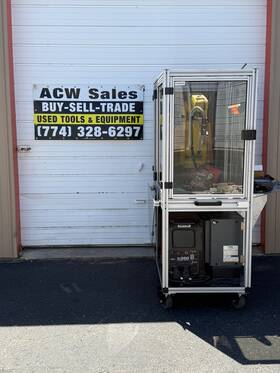
( Brand: Fanuc ), ( Manufacturer Part Number: R-350 ), ( Model: FANUC ROBOT ARC MATE 50IC / 5L R-30 LINCOLN R-350 ), ( Type: Robotic Arm Assembly ), ( Construction Type: Tig Welding ), ( Country Of Origin: Japan )
Review FANUC Tig Welding System Robot Arc Mate 50ic/5l R-30 Lincoln Can Ship
The **FANUC R-350iA/TIG Welding Robot** paired with the **ArcMate 50iC/5L R-30** from Lincoln Electric represents a cutting-edge, high-performance solution for precision TIG (Tungsten Inert Gas) welding in industrial and manufacturing environments. This advanced robotic system combines FANUC s renowned robotic precision with Lincoln s industry-leading welding expertise, delivering unmatched reliability, flexibility, and efficiency for applications requiring superior weld quality and repeatability. The **R-350iA** is a compact yet robust 6-axis articulated robot with a payload capacity of up to **35 kg (77 lbs)**, making it ideal for medium to large-scale welding tasks while maintaining a compact footprint that optimizes workspace utilization. Its **high-speed, high-accuracy** motion control achieved through FANUC s **iA Series** technology ensures smooth, jitter-free arcs, even at rapid traverse speeds, which is critical for TIG welding, where consistency in travel speed directly impacts bead uniformity and penetration. The robot s **redundant drive system** enhances durability, reducing downtime in demanding production environments, while its **compact joint design** minimizes interference with surrounding equipment, making it well-suited for tight or integrated manufacturing cells.
The **ArcMate 50iC/5L R-30** serves as the perfect complement to the R-350iA, offering a **compact, lightweight, and highly maneuverable** welding solution for smaller parts or applications where space is limited. With a **payload capacity of 5 kg (11 lbs)**, this 6-axis robot excels in precision tasks such as **aerospace components, medical devices, automotive trim, and custom fabrication**, where fine control and repeatability are paramount. Both robots integrate seamlessly with **Lincoln s advanced TIG welding power sources**, including the **Power Wave R** or **Power Wave TIG**, which deliver **pulse TIG, AC/DC balance control, and adaptive arc technology** to optimize weld quality across a variety of materials, including stainless steel, aluminum, copper, and exotic alloys. The **adaptive arc control** feature dynamically adjusts amperage and travel speed in real time, compensating for variations in material thickness or joint fit-up, ensuring consistent welds even with inconsistent workpieces a feature particularly valuable in high-mix, low-volume production environments.
The **FANUC R-350iA/TIG system** is equipped with **FANUC s iRVision** or **iRVision ** vision systems (optional), enabling **automated part positioning, seam tracking, and weld quality inspection** without human intervention. This capability eliminates the need for manual setup adjustments, significantly reducing cycle times and improving first-pass weld success rates. The system s **FANUC Robotics Controller (R-30iB/5 or R-30iA/5)** provides **high-speed processing, intuitive programming via FANUC s Easy Programming (EP) or Teach Pendant**, and seamless integration with **MES (Manufacturing Execution Systems), ERP, and CAD/CAM software** for full digital workflow automation. Additionally, the **R-350iA s compact yet powerful servo motors** and **high-resolution encoders** ensure **sub-millimeter positioning accuracy**, which is essential for TIG welding, where even slight deviations can affect weld integrity. The **R-350iA s extended reach (up to 1,700 mm)** and **wide working envelope** further enhance its versatility, allowing it to access hard-to-reach areas while maintaining stability.
For operators, the **ArcMate 50iC/5L R-30** offers an **ergonomic, user-friendly interface**, with a **lightweight design (only 25 kg)** that reduces fatigue during manual setup or small-part handling. Its **high-speed motion capabilities (up to 3,000 mm/s)** and **smooth, silent operation** make it ideal for applications requiring rapid reconfiguration or integration into automated cells. Both robots support **FANUC s iPendant**, a **touchscreen-operated teach pendant** that simplifies programming, path editing, and real-time monitoring, while the **FANUC Robotics Software Suite** (including **RobotStudio for offline programming**) allows engineers to simulate and optimize weld paths before physical setup. The system s **Lincoln Electric welding power sources** are engineered for **long-term reliability**, featuring **solid-state controls, advanced cooling systems, and easy maintenance access**, reducing downtime and extending equipment lifespan.
This **FANUC R-350iA/TIG ArcMate 50iC/5L R-30** combination is not just a welding solution it s a **complete automation platform** designed for manufacturers seeking to **minimize labor costs, maximize productivity, and achieve premium weld quality** in high-precision applications. Whether used for **aerospace structural welding, custom fabrication, medical device manufacturing, or automotive trim**, this system delivers **unmatched versatility, repeatability, and adaptability**, making it a strategic investment for businesses aiming to stay ahead in competitive industries. With **FANUC s global support network, Lincoln s welding expertise, and the flexibility of a modular robotic cell**, this setup is poised to drive efficiency, reduce waste, and elevate the standard of automated TIG welding in modern manufacturing.
### **Pros and Cons of Buying a Fanuc R-350iA/TIG Welding Robot (Arc Mate 50iC/5L R-30 with Lincoln Power Source)**
#### **Pros**
1. **High Precision and Consistency**
The Fanuc R-350iA is a high-end industrial robot known for its exceptional repeatability ( 0.05 mm) and accuracy. This ensures consistent weld quality, reducing defects and rework, which is critical in aerospace, automotive, and medical manufacturing where precision is non-negotiable.
2. **Advanced TIG Welding Capabilities**
The robot is designed for TIG (Tungsten Inert Gas) welding, which is ideal for thin materials, stainless steel, aluminum, and exotic alloys. The Arc Mate 50iC/5L platform integrates seamlessly with Lincoln Electric s power sources (such as the Power Wave or Hyperwave series), providing stable arc control, pulse welding, and advanced process monitoring. This makes it suitable for high-end applications like custom fabrication, artistic welding, and complex joint configurations.
3. **Versatility and Flexibility**
The R-350iA has a 350 kg payload capacity and a 1,300 mm reach, allowing it to handle a wide range of workpieces, from small intricate parts to larger assemblies. The 5-axis configuration (with wrist rotation) enables multi-sided welding and access to hard-to-reach areas without repositioning the workpiece. This flexibility reduces setup time and increases productivity.
4. **Integration with CAD/CAM and Offline Programming**
Fanuc s RobotStudio software allows for offline programming (OLP), where weld paths can be programmed and simulated before the robot operates. This reduces downtime and minimizes errors during actual production. The system can also integrate with CAD files (e.g., SolidWorks, AutoCAD) for seamless path generation.
5. **Durability and Reliability**
Fanuc robots are built for industrial environments, with robust construction, high-speed motors, and minimal wear components. The R-350iA is designed for 24/7 operation, making it a long-term investment with low maintenance requirements compared to manual welding or less robust automation solutions.
6. **Safety Features**
The robot includes safety features such as collision detection, emergency stop functionality, and programmable safety zones. When paired with a Lincoln power source, it also offers arc monitoring to prevent overheating or equipment damage.
7. **Cost Savings Over Time**
While the initial investment is high, the robot reduces labor costs by automating repetitive welding tasks. It also minimizes material waste due to precise control, lowers defect rates, and extends the lifespan of tools and consumables (e.g., tungsten electrodes, shielding gas) through optimized welding parameters.
8. **Scalability and Future-Proofing**
The Fanuc ecosystem supports upgrades, such as adding vision systems (for part alignment), additional axes, or integration with MES (Manufacturing Execution Systems) for Industry 4.0 compliance. This makes the system adaptable to evolving manufacturing needs.
9. **Support and Warranty**
Fanuc has a global network of authorized service providers, ensuring quick access to technical support, spare parts, and training. Lincoln Electric also provides robust customer service for their power sources, further reducing downtime risks.
10. **Aesthetic and Custom Fabrication Appeal**
For businesses specializing in artistic or high-end custom welding (e.g., sculptures, architectural metalwork, or luxury automotive parts), the TIG robot s ability to produce clean, visually appealing welds with minimal spatter is a significant advantage over manual methods.
---
#### **Cons**
1. **High Upfront Cost**
The Fanuc R-350iA, when paired with a Lincoln power source, offline programming software, and necessary peripherals (e.g., workholding, safety guards), can cost **$200,000 to $400,000 **, depending on configuration. This makes it inaccessible for small shops or startups with limited budgets. The ROI may take several years to realize, especially if the workload isn t high enough to justify full utilization.
2. **Complex Setup and Training**
Programming a TIG welding robot requires specialized knowledge of Fanuc s teaching pendant, RobotStudio, and welding process parameters (e.g., amperage, travel speed, gas flow). Operators and programmers need extensive training, which can be costly and time-consuming. Many shops may lack in-house expertise, requiring external consultants or prolonged downtime for training.
3. **Space and Infrastructure Requirements**
The robot occupies a significant footprint (approximately 2.5m x 2.5m for setup) and requires proper ventilation (for fumes), electrical capacity (for the power source), and a clean, controlled environment to maintain precision. Smaller workshops may struggle to accommodate the system without major facility upgrades.
4. **Maintenance and Downtime**
While Fanuc robots are durable, they are not maintenance-free. Regular calibration, motor servicing, and software updates are necessary to prevent degradation in performance. Lincoln power sources also require periodic maintenance (e.g., electrode cleaning, gas flow checks). Unplanned downtime can occur if spare parts are not readily available or if technical issues arise.
5. **Limited to TIG Welding (Unless Expanded)**
The R-350iA is primarily optimized for TIG welding. While it can perform MIG or stick welding with additional tooling, its performance may not match specialized MIG robots (e.g., Fanuc s Arc Mate 120iA) for high-volume production. Businesses relying on multiple welding processes may need to invest in additional robots or adapt workflows accordingly.
6. **Depreciation and Resale Value**
Industrial robots depreciate quickly. While Fanuc holds its value better than some competitors, resale prices for a used R-350iA may not recover a significant portion of the original cost after 5 10 years. This can be a concern for businesses planning to upgrade or sell the equipment in the future.
7. **Learning Curve for Workpiece Handling**
Unlike MIG robots, which often handle sheet metal in continuous motion, TIG welding frequently requires manual or robotic part positioning (e.g., rotating workpieces for multi-sided welds). This may necessitate additional automation (e.g., turntables, manipulators) or manual intervention, adding complexity to the process.
8. **Gas and Consumable Costs**
TIG welding requires argon or helium shielding gas, which can be expensive, especially for large or complex welds. Additionally, tungsten electrodes, collets, and other consumables add to the ongoing operational costs. While the robot reduces waste, these expenses must be factored into the total cost of ownership.
9. **Integration Challenges**
Seamless integration with existing ERP, MES, or quality control systems may require custom programming or third-party software. Some shops may find the transition from manual or semi-automated processes disruptive, leading to initial inefficiencies.
10. **Overkill for Low-Volume or Simple Applications**
If a business only performs occasional or straightforward TIG welding (e.g., small batches of similar parts), the robot may underutilized. In such cases, a manual welder or a simpler robotic solution (e.g., a 4-axis MIG robot) could be more cost-effective.
---
### **Conclusion**
The **Fanuc R-350iA/TIG welding robot paired with a Lincoln power source** is a **premium automation solution** best suited for businesses that require **high-precision, repeatable TIG welding** in demanding industries such as aerospace, medical device manufacturing, automotive custom fabrication, or artistic metalwork. Its strengths lie in **consistency, flexibility, and integration capabilities**, making it ideal for high-mix, low-volume production or complex welds where manual methods would be impractical.
However, the **high initial cost, steep learning curve, and space requirements** make it impractical for small shops, startups, or businesses with **low welding volumes or simple repetitive tasks**. The decision to invest should be based on:
- **Workload demand** (Is the robot fully utilized to justify costs?)
- **Skill availability** (Does the team have or can they acquire the necessary expertise?)
- **Long-term goals** (Will the robot support future growth or Industry 4.0 initiatives?)
- **Alternative solutions** (Could a manual welder, simpler robot, or hybrid approach achieve similar results at lower cost?)
For businesses that meet these criteria, the R-350iA is a **superior long-term investment** that enhances productivity, quality, and scalability. For others, exploring **entry-level robotic welding systems, hybrid solutions, or outsourcing** may be more financially prudent.
---
### **Recommendation**
**Buy the Fanuc R-350iA/TIG robot if:**- You operate in a **high-precision, low-volume, high-value industry** (e.g., aerospace, medical, luxury automotive, or custom fabrication).
- Your **welding workload is complex, repetitive, or requires TIG for thin/gauge materials**.
- You have **access to training or can invest in hiring skilled programmers**.
- You can **justify the cost with measurable ROI** (e.g., reduced labor costs, fewer defects, increased throughput).
- Your **facility and infrastructure** can support the robot s requirements.
**Avoid or consider alternatives if:**- Your **budget is limited**, and you cannot secure financing or leasing options.
- Your **welding volume is low**, making the robot underutilized.
- You lack **expertise in robotic programming
Details:
Lincoln R-350 Power Wave welder. Needs to be put back together.
part #: r350 prices
- $11000.00-$25999.00
specifications robotiindustri:
- brand: Fanuc
- mpn: R-350
- model: Fanuc Robot Arc Mate 50ic / 5l R-30 Lincoln R-350
- type: Robotic Arm Assembly
- construction type: Tig Welding
- country of origin: Japan
shipping robotiindustri:
seller robotiindustri:
- city: Lynn Haven, Florida
- rating: 100.0%
- # reviews: 834
payments robotiindustri:
- credit card: Discover
- other
- wallet: Apple-pay
offer robotiindustri:
- quantity: 1
- started: April 12, 2026
- availability: In Stock
- sold: 0
- options: Seller-arranged-local-pickup
returns robotiindustri:
- policy: No Returns
general robotiindustri:
- condition: Used
- Business Industrial > Industrial Automation Motion Controls > Industrial Robotic Arms
Fanuc R-350 Is Similar To:
- Fanuc 100i Prices Stand Robot Arcmate (46.4% similar) This is a robot stand for a arc mate 100I with a RJ3 controller, it is make out of steel and painted yellow...(May 31st, 2015)
- Rj2 Arcmate 100i Arc Nr Robot Welding Fanuc Industrial Clean M6i Prices (32.9% similar) Robot will come in steel skid. All of our robots are tested and in a condition...(June 8th, 2015)
- 100ibe Fanuc Welding Robot Arcmate (47.7% similar) Fanuc arc mate 100IB robot with RJ3IB control, tested exclusive weld package comes arc mate robot, welding torch, cables, teach pendant lincoln I400 power source manual included we skid load for free specifications -axes: 6 -payload: kg -h-reach: 1373MM -repeatability. Manual included we skid load ...(October 11th, 2017)
- Welding Tested 455 Robot 120ib Rj3ib Arcmate Industrial Multiple Fanuc (42.8% similar) ...(May 31st, 2015)
- 165cf Fanuc Robotic System Controller Complete (38% similar) Fanuc R-2000IB 165CF w R30IA controller complete robotic system. R30IA controller i-pendant year: hours: see video of robot under power coming soon...(August 14th, 2018)
- Fanuc Video Robot 16ib Multiple Tested Rj3ib M16ib 20 Control Hrs (29.8% similar) ...(May 22nd, 2015)
- 2040-t107 Fanuc Lr Mate Robot (28.8% similar) Fanuc 2040-T107 Lr mate robot control ribbon cable...(May 23rd, 2017)
- -30ia Testing System Ic Lr Robot Fanuc Chip Mate 200ic Robotic Packaging Tested (50.6% similar) Utilizing Fanuc robot, sick 3d sensor. Package comes with Fanuc Lr mate 200IC 5h high speed version robot robot control r 30IA mate color pendant the pendant is a color, internet ready teach pendant revision complete micro chip robotic handling, test and inspection work cell work cell robotic cell ...(May 31st, 2015)
- 4042-t026 L1r003 Fanuc Robot Power And Communication Cable (33.1% similar) ...(November 7th, 2018)
- 420-430 Fanuc Automatic Robotic Palletizing System Robot Palletizer (42.3% similar) ...(March 9th, 2018)
- 430iw Fanuc Industrial Robot With Rj3 Controller Tested Multiple Available (34.9% similar) ...(October 5th, 2015)