DENSO HM-40A02M-W Scara Robot Repaired 4-AXIS 10KG 1000MM
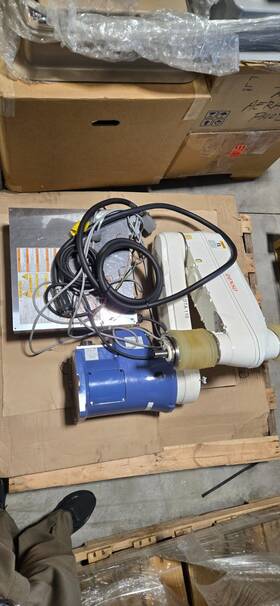
( Brand: Denso ), ( Manufacturer Part Number: HM-40A02M-W ), ( Type: Complete Robotics Systems ), ( Arm Reach: 1000mm ), ( Payload: 10 Kg ), ( Robotics Controls Type: Arm ), ( Construction Type: Handling ), ( Country Of Origin: Japan )
Review DENSO 4-axis Scara Robot 10kg 1000mm Needs Repaired
The **Denso HM-40A02M-W (2013 model) 4-axis SCARA robot**, a refined and meticulously restored unit capable of handling payloads up to **10 kg** with an impressive reach of **1000 mm**, represents a robust and versatile solution for high-speed, precision-driven automation tasks. Engineered by Denso, a pioneer in robotic innovation, this SCARA (Selective Compliance Assembly Robot Arm) model combines reliability, efficiency, and adaptability, making it ideal for applications in assembly, packaging, material handling, and pick-and-place operations. The **4-axis configuration** comprising a base rotation, shoulder joint, elbow joint, and wrist articulation enables seamless maneuverability in tight spaces while maintaining exceptional repeatability and accuracy, critical for industries where consistency and speed are paramount. Originally manufactured in **2013**, this unit has been **thoroughly repaired and restored**, ensuring all mechanical, hydraulic, and electrical components operate at peak performance. The **10 kg payload capacity** allows for the handling of a wide range of materials, from lightweight components to moderately heavy parts, while the **1000 mm reach** provides ample workspace for complex tasks without compromising precision. Equipped with Denso s advanced servo technology, this robot delivers smooth, jitter-free motion, reducing cycle times and minimizing wear on both the machine and the processed materials. Whether integrated into a high-volume production line or deployed in a specialized application requiring dexterity and reliability, this SCARA robot stands as a testament to Denso s legacy of precision engineering, offering a cost-effective yet high-performance solution for modern manufacturing challenges.
**Pros and Cons of Buying a Used Denso HM-40A02M-W (2013, 4-Axis SCARA Robot, 10kg Payload, 1000mm Reach)**
### **Pros**
1. **Cost-Effective Solution** A well-maintained used SCARA robot like this can offer significant savings compared to purchasing a new model. The Denso HM-40 series is a reliable brand, and a repaired unit may retain much of its original value while being far cheaper than a brand-new equivalent.
2. **Proven Reliability** Denso robots are known for their durability and precision. The HM-40 series, in particular, is widely used in pick-and-place, assembly, and packaging applications, with a strong track record of consistent performance over years of operation.
3. **Compatibility with Modern Systems** Despite being from 2013, this model can integrate with contemporary control systems, PLCs, and vision systems, especially if the repair includes software updates or compatibility checks. Many manufacturers still support older Denso models with firmware updates or retrofitting options.
4. **Lower Operational Costs** SCARA robots like this are energy-efficient compared to larger industrial robots, and their compact design reduces floor space requirements. A repaired unit may also have lower maintenance costs if the repair work was thorough and included critical components like servos, motors, and controllers.
5. **Proven Performance in Specific Tasks** The 10kg payload and 1000mm reach make this robot suitable for tasks such as part handling, assembly, labeling, and simple material sorting. Its 4-axis configuration allows for flexible positioning without the complexity of a full 6-axis arm, making it ideal for repetitive linear or rotational movements.
6. **Resale and Trade-In Value** If the robot is well-documented and comes with a warranty or service history, it may hold value in the secondary market. Some buyers prefer used robots from reputable brands like Denso due to their longevity.
7. **Easier to Maintain Than Newer Models** Older models often have simpler control architectures, which can make troubleshooting and maintenance easier for operators familiar with industrial automation. Spare parts may also be more readily available than for newer, discontinued models.
---
### **Cons**
1. **Age-Related Wear and Potential Hidden Issues** A 2013 robot, even if repaired, may have accumulated wear in joints, bearings, or electrical components over time. The repair work must be thoroughly documented, and a pre-purchase inspection (or trial run) is essential to verify that critical parts like servos, cables, and controllers are in good condition.
2. **Software and Firmware Limitations** Older models may lack support for the latest programming languages, safety standards (e.g., ISO 13849, SIL), or connectivity options (e.g., Ethernet/IP, OPC UA). If your application requires modern safety features or cloud integration, compatibility issues could arise.
3. **Depreciation Risk** While a used robot saves upfront costs, its residual value may depreciate faster than a newer model. If you plan to upgrade in the future, the trade-in value of this robot may not cover the cost of a more advanced system.
4. **Potential for Obsolete Components** Some parts, such as specific servos, drives, or even the robot s controller, may become harder to source as Denso phases out older models. The repair must include spare parts inventory to mitigate this risk.
5. **Limited Warranty or Service History** If the robot was not maintained properly before the repair, there could be latent defects. A warranty from the seller or repair provider is crucial, but even then, it may not cover all potential future failures. Ensure the repair includes a test run and documentation of all work performed.
6. **Integration Challenges** Older robots may require additional hardware or software bridges to work seamlessly with modern PLCs, HMI systems, or vision systems. Retrofitting could add unexpected costs if the seller does not provide compatibility guarantees.
7. **Energy Efficiency Compared to Newer Models** While SCARA robots are inherently energy-efficient, newer models often incorporate advanced power-saving features (e.g., regenerative braking, adaptive control). A 2013 unit may consume slightly more power for equivalent tasks.
8. **Training and Skill Dependency** Operators familiar with newer robot programming environments (e.g., Denso s latest IDE) may need additional training to work with this older model. This could increase operational costs if specialized training is required.
---
### **Ending Conclusion**
Buying a used Denso HM-40A02M-W (2013, repaired) can be a **cost-effective and practical choice** for applications requiring a reliable, mid-range SCARA robot with a 10kg payload and 1000mm reach. The brand s reputation for durability, combined with the potential for significant savings, makes this option attractive for businesses with budget constraints or specific task requirements. However, the decision is not without risks hidden wear, software limitations, and potential compatibility issues must be carefully evaluated.
**For this purchase to be justified:**- The robot must come with **detailed repair documentation**, a **warranty or service agreement**, and a **pre-purchase inspection or trial run**.
- The application must align well with the robot s capabilities (e.g., simple pick-and-place, assembly, or labeling tasks).
- The buyer should be prepared for **potential integration challenges** and **long-term maintenance planning**, including sourcing spare parts.
- If the robot will be used in a safety-critical application, ensure it meets current safety standards (e.g., through retrofitting or certification).
**For businesses that can afford it, a newer Denso model or a well-supported used robot from a different brand (e.g., Fanuc, ABB, or Yaskawa) might offer better long-term reliability and compatibility.** However, if the budget is tight and the robot is thoroughly vetted, the HM-40A02M-W can be a **sound investment** for the right use case.
---
### **Recommendation**
**Proceed with caution and due diligence.** If you decide to purchase this robot:1. **Verify the repair quality** Insist on seeing proof of work done on critical components (e.g., servos, joints, wiring). Request a test run to confirm performance.
2. **Check software compatibility** Ensure the robot s firmware supports your PLC, vision system, or safety requirements. Consider retrofitting if necessary.
3. **Assess long-term support** Confirm that spare parts and technical support are available from the seller or a third-party provider.
4. **Compare total cost of ownership** Factor in maintenance, training, and potential downtime risks against the upfront savings.
5. **Consider alternatives** If possible, explore newer used models or refurbished units from the same manufacturer, as they may offer better warranty coverage and compatibility.
**Best for:** Small to medium-sized businesses with **budget constraints**, **simple automation needs**, and **access to maintenance resources**. Ideal for **pick-and-place, assembly, or packaging tasks** where precision and reliability are critical but where cutting-edge features are not required.
**Not ideal for:** Applications requiring **high-speed, complex motion profiles**, **advanced safety certifications**, or **long-term scalability** without potential upgrades. Avoid if the buyer lacks **in-house technical expertise** to troubleshoot or maintain the robot.
Details:
Denso HM-40A02M-W, This robot has very little use. It was to be used on a medical assembly system and the drug ultimately did not get FDA approval program cancelled. Unfortunately, we had a college intern who attempted to use this in senior project and caused damage the internal circuitry by misfiring it.
part #: hm40a02m price
- $2500.00
specifications robotiindustri:
- brand: Denso
- mpn: Hm-40a02m-w
- type: Complete Robotics Systems
- arm reach: 1000mm
- payload: 10 Kg
- robotics controls type: Arm
- construction type: Handling
- country of origin: Japan
payments robotiindustri:
- other
- credit card: Visa
- wallet: Google-pay
offer robotiindustri:
- options: Seller-arranged-local-pickup
- quantity: 1
- started: May 7, 2026
- sold: 0
- availability: In Stock
shipping robotiindustri:
returns robotiindustri:
- policy: No Returns
general robotiindustri:
- condition: For parts or not working
- Business Industrial > Industrial Automation Motion Controls > Industrial Robotic Arms
seller robotiindustri:
- city: Fort Wayne, Indiana
- rating: 100.0%
- # reviews: 78
Denso HM-40A02M Is Similar To:
- 410000-6400 Denso Robot Controller (27.5% similar) ...(December 27th, 2018)
- 410000-8270 411000-1380 Denso Vs-6577e-p100 Cleanroom 6-axis Articulated (28.6% similar) Our cut-of time for shipping an item is 3:45PM ct. Messaging: though messages. If lift-gate service is needed, fees may apply...(January 4th, 2017)
- 410100-1630 Denso Robot Teaching Pendant (31.5% similar) Shipped USPS priority mail any lower 48. Denso robot teaching pendant MP7 8J3P4. Condition is good used 100% functional...(April 20th, 2019)
- 410100-1640 Denso New Robot Teach With Cable (32.1% similar) Comes with 30-DAY warranty frees for the continental us. New not boxed, no key Denso MP7ME3P8 robot teach mini-pendant with 8m cable...(November 28th, 2018)
- 410200-0530 Denso Robot Controller And Pendant (26.3% similar) If you would like to use your shipping account number, please with that information. Buyer may inspect the equipment prior to purchase and placement of order inspection is deemed a waiver buyers right. Item comes as shown in pictures, if a part is not pictured, or mentioned the , then it included ...(June 9th, 2019)
- 410500-840 Denso Wave Robot Arm (30.3% similar) ...(January 18th, 2019)
- 410622-0790 05b08 Msm012w6b Denso Robot Part (25% similar) 00FLUKE trend b clock ram T13140 1,000. 00LOT of 500 250LDB, 022806, MSD28774, 21AA13C PCB boards T75498 us NOW1636539 a 05869ASSY T13139 1,000. working pneumatic slighting laser material handling packing more industrial equipment electrical equipment tools heating cooling motors transmissions ...(November 29th, 2018)
- 410100-0440 Teaching Pendant Denso Tp3 Robot With Cable (26% similar) No signs of damage and all pins connectors are perfect. Denso TP3 robot teaching pendant with CABLE410100 0440 this is unit is in extremely good condition, very clean day money back guaranty. Looks almost brand new...(August 25th, 2016)
- Hs-45452g Denso Custom 4-axis Scara Robot W Controller (49.2% similar) Please for a quote. Includes power cable, manipulator cable, I o cable, and e stop. Mounting plate not included. Cables in original packaging...(October 15th, 2016)
- Rc5-hme4ba-bp Hm-40702e2m Denso Robot Arm Controller Teaching Pendant D20 (34% similar) Hello, you are buying on a Denso hm 40702E2M robotic arm with the following components as shown Denso hm 40702E2M robot arm Denso RC5 HME4BA BP control unit Denso Twp RC5 1 teaching pendant with cable all original cables as shown 1 attached head assembly as shown 1 unattached head assembly as shown ...(September 24th, 2016)
- Tp-rc5-1 Denso Rc5 Hand Held Robot Pendant (32.7% similar) Used in good condition. Denso robot pendant model Twp RC5...(October 5th, 2016)