YASKAWA 140775-1 Motoman Robotic Welding Turntable Rotary Positioner 300KG Table Pos
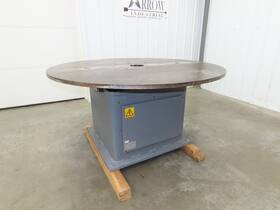
( Brand: Yaskawa ), ( Manufacturer Part Number: 140775-1 ), ( Part Type: Table )
Review YASKAWA Motoman Robotic Welding Turntable Positioner 300kg Rotary Table Pos
The **Yaskawa Motoman 140775-1 Rotary Table Positioner** is a high-performance, precision-engineered rotary table designed to enhance the efficiency, flexibility, and repeatability of robotic welding applications within industrial manufacturing environments. Part of Yaskawa s renowned Motoman robotic suite, this **300kg capacity rotary table positioner** (Model 140775-1) is engineered to deliver seamless integration with Motoman s advanced robotic arms, enabling automated material handling, welding, and positioning tasks with unmatched accuracy and reliability. Built with robust construction, the positioner features a **smooth, low-friction rotary mechanism** driven by a high-torque servo motor, ensuring precise angular positioning with minimal backlash and vibration, even under heavy loads. Its **compact yet sturdy design** allows for easy installation in tight spaces, making it ideal for applications in automotive, aerospace, shipbuilding, and heavy machinery fabrication where space optimization is critical.
The **140775-1 rotary table** incorporates Yaskawa s proprietary **Motoman Motion Control System**, which provides seamless communication with the robotic controller, enabling synchronized movement between the robot and the positioner for flawless arc welding, spot welding, or assembly operations. With a **360-degree continuous rotation**, it accommodates a wide range of part orientations, reducing the need for manual re-positioning and minimizing setup time. The table s **rigid, high-strength construction** often featuring reinforced steel or cast iron components ensures stability even when handling heavy or irregularly shaped workpieces, while its **smooth, low-maintenance bearings** extend operational longevity. Additionally, the positioner is equipped with **safety features** such as emergency stop functionality, overload protection, and precise limit switches to prevent collisions and ensure operator safety.
Beyond its core functionality, the **Yaskawa Motoman 140775-1** is designed with **modularity and adaptability** in mind, allowing for easy integration with various robotic arms, vision systems, and peripheral equipment. Its **customizable mounting options**, including flange or baseplate configurations, ensure compatibility with existing production lines, while its **high-speed indexing capabilities** enable rapid part changes, boosting overall productivity. The system s **user-friendly interface** simplifies programming and setup, enabling operators to quickly adjust positioning parameters via the robotic controller or dedicated HMI (Human-Machine Interface). Whether deployed in a high-volume production environment or a specialized fabrication shop, this rotary table positioner delivers **consistent, repeatable performance**, reducing cycle times, improving weld quality, and enhancing the versatility of automated welding cells.
For industries where precision and efficiency are paramount, the **Yaskawa Motoman 140775-1 Rotary Table Positioner** stands as a testament to Yaskawa s commitment to innovation in robotic automation. By combining **superior mechanical engineering with cutting-edge motion control technology**, this positioner not only streamlines complex manufacturing processes but also future-proofs operations for scalability and adaptability in an ever-evolving industrial landscape.
### Pros and Cons of buying a Yaskawa 140775-1 Motoman Robotic Welding Turntable Positioner (300kg Rotary Table)
#### **Pros:**1. **High Load Capacity** The 300kg payload capacity makes it suitable for heavy-duty welding applications, including large components, pipes, or structural parts. This versatility ensures it can handle a wide range of industrial tasks without frequent upgrades.
2. **Precision and Stability** Positioners like this are designed for consistent, repeatable positioning, reducing human error and improving weld quality. The rotary motion minimizes misalignment, which is critical in welding for maintaining joint integrity.
3. **Compatibility with Robotic Arms** It integrates seamlessly with Motoman (Yaskawa) robotic arms, enhancing automation workflows. This compatibility allows for synchronized movement between the robot and the positioner, improving efficiency in complex welding sequences.
4. **Durability and Build Quality** Yaskawa is a reputable brand known for robust industrial equipment. The construction of this positioner suggests it is built to withstand harsh environments, reducing downtime due to mechanical failures.
5. **Time and Cost Efficiency** By automating the positioning of heavy parts, it reduces manual labor, speeds up production cycles, and lowers operational costs in the long run. This is particularly beneficial for high-volume welding operations.
6. **Versatility in Applications** Beyond welding, it can be used for inspection, assembly, or other rotational tasks, making it a cost-effective addition to a manufacturing setup.
7. **Safety Features** Modern positioners often include safety mechanisms such as emergency stops, protective guards, and collision detection, reducing workplace hazards.
8. **Long-Term Reliability** With proper maintenance, Yaskawa equipment is known for longevity, providing a solid return on investment over years of use.
---
#### **Cons:**1. **High Initial Cost** Industrial robotic positioners are expensive upfront. The cost of purchasing, installing, and integrating this equipment may be prohibitive for small businesses or startups with limited budgets.
2. **Maintenance and Training Requirements** Operating and maintaining robotic positioners requires skilled personnel. Training workers to use the equipment effectively and perform routine maintenance can add to operational costs.
3. **Space Constraints** Positioners of this size require significant floor space. Facilities with limited workspace may struggle to accommodate it without redesigning their layout.
4. **Complexity in Setup and Programming** Integrating the positioner with robotic arms and control systems may require technical expertise. Poor setup or programming errors could lead to inefficiencies or equipment damage.
5. **Potential Downtime for Repairs** If the positioner malfunctions, repairs or replacements could halt production until the issue is resolved. This risk is higher if spare parts are not readily available.
6. **Energy Consumption** Industrial robots and positioners consume significant power. For facilities with high energy costs, this could impact overall operational expenses.
7. **Limited Mobility** Unlike manual positioners, this is a fixed installation. Moving it to different workstations would require significant effort and additional equipment.
8. **Depreciation Over Time** While durable, robotic equipment depreciates. Businesses must weigh the long-term value against newer, more advanced models that may emerge with improved features.
---
### **Conclusion:**The Yaskawa 140775-1 Motoman Robotic Welding Turntable Positioner is a high-performance tool ideal for industries requiring precise, automated positioning of heavy components. Its strengths lie in its load capacity, compatibility with robotic systems, and long-term reliability, making it a valuable asset for large-scale manufacturing, welding shops, or automated assembly lines. However, the high upfront cost, maintenance demands, and space requirements may pose challenges, particularly for smaller operations or those with limited technical resources.
For businesses with the budget and infrastructure to support such equipment, this positioner can significantly enhance productivity and weld quality. Conversely, smaller or resource-constrained businesses might find it more cost-effective to start with a manual or semi-automated alternative before investing in full automation.
### **Recommendation:**- **For Large Manufacturers or Welding Shops:** If your operation involves heavy-duty welding, high-volume production, or complex robotic automation, this positioner is a strong investment. Ensure your facility has the space, technical support, and budget to maintain it effectively.
- **For Smaller Businesses or Startups:** Consider starting with a manual or semi-automated positioner to test the need for full automation. Alternatively, explore leasing options or used equipment to reduce initial costs while evaluating long-term benefits.
- **For Custom Applications:** If your workflow requires specialized features (e.g., tilt capabilities, custom payloads), verify whether this model meets your needs or if additional accessories are required.
Ultimately, the decision should align with your business s scale, production demands, and financial capacity. Conduct a thorough cost-benefit analysis, including operational savings, productivity gains, and long-term ROI, before making a purchase. Consulting with a Yaskawa distributor or robotic integration specialist can also provide tailored insights based on your specific use case.
Details:
Motor gearbox with brake. Condition Used. This has a drive and limit switches. Items in Lot1.
Looks like it was for 180 rotation. Model 140775-1. Removed From a Working Environment. And the cost of return shipping.
Ask our experts. These units were in a working welding setup. Part . Country of Manufactures.
Payload 300kg.
part #: 1407751 price
- $3999.99
specifications robotiindustri:
- brand: Yaskawa
- mpn: 140775-1
- part type: Table
seller robotiindustri:
- city: Millersburg, Indiana
- # reviews: 17466
- rating: 99.9%
payments robotiindustri:
- wallet: Google-pay
- credit card: Visa
- other
shipping robotiindustri:
returns robotiindustri:
- policy: Returns Accepted
- time: 30 Days
- paid by: Buyer
- method: Money back
offer robotiindustri:
- sold: 0
- started: February 13, 2026
- best offers: True
- availability: In Stock
- quantity: 1
- options: Ship-to-home
general robotiindustri:
- condition: Used
- Business Industrial > Industrial Automation Motion Controls > Industrial Robotic Arms
Yaskawa 140775-1 Is Similar To:
- 030-003200 Motoman Cable Yaskawa Power Lights (33.6% similar) Motoman cable Yaskawa - power 3 lights 6FT new old stock...(August 15th, 2018)
- 132350-10 Yaskawa Motoman Robot I-o (38% similar) 8 this unit is in excellent condition guaranteed to work. Unit 1a b, st. Tel: queens ton st. Yaskawa motoman robot I o cable assembly rev...(April 8th, 2017)
- 132350-2 Yaskawa Motoman Robot I-o (38.3% similar) Tel: queens ton st. Yaskawa motoman robot I o cable assembly rev. 8 this unit is in excellent condition guaranteed to work. Unit 1a b, st...(June 8th, 2017)
- 133181-1 Yaskawa Motoman Sk6-mrc 5-axis (33.6% similar) This does not mean the items displayed at and sold through site do work...(June 30th, 2017)
- 80nel30r2-h 13k62766-10-12 Yaskawa Motoman Tech Pendent Programming Avail Qty Warranty (33.7% similar) However larger items and quantity orders take more time to pack. Customer should in advance to schedule for a pickup. Boxes, APO, FPO and military bases...(October 13th, 2015)
- 142313-1 Motoman Yaskawa Xrc Teach (30% similar) Motoman Yaskawa RC teach pendant cable...(July 6th, 2017)
- 142740-4 Yaskawa Motoman Yasnac Xrc Teach Pendant Membrane (36.1% similar) Snack RC teach pendant membrane...(September 20th, 2018)
- 142958-1 Yaskawa Motoman Robot Xrc (38.3% similar) Unit 1a b, st. Tel: queens ton st...(March 26th, 2017)
- 142959-1 Yaskawa Motoman Hw9271140-5-n Robot (32.3% similar) Unit 1a b, st...(March 26th, 2017)
- 142995-2 Yaskawa Motoman 9947 Robot (34.7% similar) unit 1a b, st. Tel: queens ton st...(March 26th, 2017)
- 147406-5 Yaskawa Brand New No Box Motoman Robot Harness (38.3% similar) Items listed new are in factory packaging. For pickup arrangements please also contact. 30 day money back guarantee with any questions thru messaging. If ups or FedEx is required to ship due weight size, extra charges may apply...(December 25th, 2018)